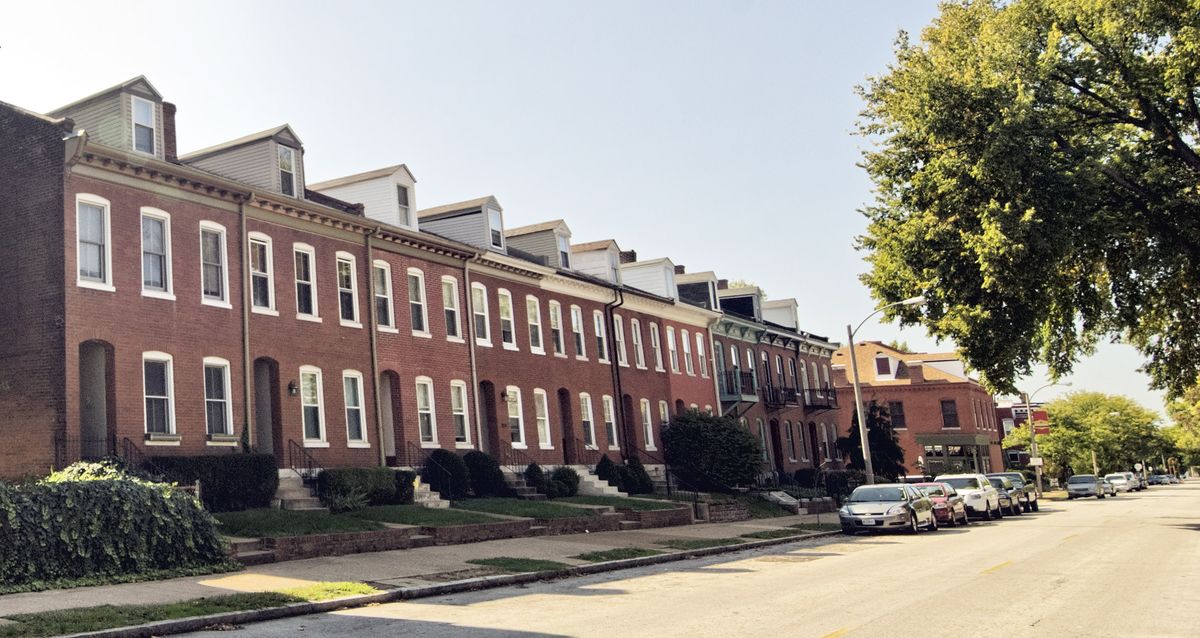
Benton Park sits just west of Soulard, on the other side of Interstate 55, and it shares a lot of its neighbor's DNA: 19th-century brick, German brewing roots, and streets that reward a slow walk. What it has that Soulard doesn't is a little more quiet, a leafy park at its center, and a genuinely strange geological quirk — the neighborhood is built on top of caves. Those caves are the reason the brewers came, and the brewers are the reason so much of what's worth seeing here exists at all.
A park where the cemetery used to be
The neighborhood takes its name from its park, and the park has an unusual origin. From 1842 to 1865 the site was the City Cemetery. The burials were relocated in 1865, and on June 25, 1866, a city ordinance created what was first called City Park on the 17-acre site, later trimmed to about 14 acres once the surrounding streets were cut through. It was renamed for Thomas Hart Benton, the first U.S. Senator from Missouri.
Horticulturist Edward F. Krausnick shaped the landscape around the natural rise and fall of the ground — itself partly the work of the cave underneath — adding two lakes, a circular fountain, and rustic stone bridges. Most of the Victorian plantings are long gone, but the stone bridges and fountain are still there. One of the lakes was later rehabilitated and is regularly stocked with fish, and the park now has a pavilion, picnic tables, tennis courts, and a playground. Look for the granite monument to Colonel Friedrich Hecker, a Civil War regiment commander, dedicated in 1882.
Beer, and the caves that made it possible
Before refrigeration, St. Louis brewers needed somewhere cold to lager their beer, and Benton Park had it built in: natural caverns that held a constant 55 degrees. Among the area's first industries were brickyards, a ropewalk, and breweries, and the most important of them was the Lemp family's. Adam Lemp founded the business in 1840; his son William J. Lemp took over in 1862 and moved the operation to a site at Cherokee and 13th Streets, drawn by a cave there that made a natural cooling cellar. By the 1870s it was the largest brewery in the city. Unlike Anheuser-Busch, it closed during Prohibition and never reopened, but the brewery buildings still stand.
The cave had a second life, too. Pharmaceutical manufacturer Lee Hess, who bought the DeMenil property in 1940, opened the caves beneath it to visitors as Cherokee Cave, and paleontologist George Gaylord Simpson studied prehistoric animal remains found there, including peccary fossils.
Two mansions on DeMenil Place
The Lemp Mansion, at 3322 DeMenil Place, was the Lemp family home and the brewery's offices, and it's the neighborhood's most famous address — partly for its architecture and partly for its reputation. Three members of the family died by suicide there, and the house is widely billed as haunted. The Pointer family bought and restored it in the 1970s and turned it into a restaurant and an inn with six suites. Today it serves dinner, an all-you-care-to-eat family-style fried chicken dinner on Sundays, a comedy murder-mystery dinner theater on Friday and Saturday nights, and guided history-and-ghost tours of three floors of the house. The Pointers put the property up for sale in September 2026 and have said the restaurant and inn will keep operating through December 31, 2027.
A short walk down the same street is the Chatillon-DeMenil Mansion, at 3352 DeMenil Place. It was begun in 1848 as a farmhouse for the frontiersman Henry Chatillon, then enlarged between 1855 and 1863 by Nicolas DeMenil into the columned Greek Revival house that stands there now. It came close to being lost: the path of Interstate 55 was going to take it, until a 1961 route change spared it. It's now a house museum, with guided tours Wednesday, Thursday, and Saturday from March through December at 11 a.m., 12:30 p.m., and 2 p.m. The tours cover old French St. Louis, the western fur trade, and Victorian daily life, and the third floor holds a collection of memorabilia from the 1904 World's Fair.
Brick streets and a very old pretzel shop
Benton Park was listed on the National Register of Historic Places in 1985 and became a City historic district in 2006. Most of its houses date to the 1880s and 1890s, built largely by German immigrants who worked in the breweries and related trades, and the neighborhood still reads that way: block after block of brick, with the kind of detail that makes it worth walking rather than driving.
Two food stops belong on any walk. Gus' Pretzels, at 1820 Arsenal Street near the Anheuser-Busch brewery, opened in 1920 and is still a family business, twisting its pretzels by hand the same way it always has; beyond the classic twist, it's known for pretzel sticks and bratwurst or hot dogs wrapped in pretzel dough. Blues City Deli, at 2438 McNair Avenue, is a sandwich shop built as a tribute to the blues, known for po'boys and muffulettas and open for lunch Monday through Saturday. After dark, the mosaic-covered Venice Café, at 1903 Pestalozzi Street, has live music Monday through Saturday from 9 p.m. to 1 a.m.
Nearby stays
No Airbnb in Benton Park yet
VisitingSTL doesn't feature a stay in Benton Park itself yet, but the Soulard property is in the neighborhood right next door, just across I-55 — the closest of the three to the Lemp Mansion and Gus' Pretzels.
See Places to Stay →Quick answers
Where is Benton Park in St. Louis?
On the city's south side, just west of Soulard. Its boundaries are Gravois Avenue to the north, Cherokee Street to the south, Interstate 55 to the east, and Jefferson Avenue to the west.
Is the Lemp Mansion still open?
Yes. The Pointer family put it up for sale in September 2026 and has said the restaurant and inn will keep operating through December 31, 2027.
When can you tour the Chatillon-DeMenil Mansion?
Guided tours run Wednesday, Thursday, and Saturday from March through December, at 11 a.m., 12:30 p.m., and 2 p.m.
Why were there so many breweries in Benton Park?
The caves beneath the neighborhood held a constant 55 degrees, which made natural cellars for lagering beer before refrigeration.
Benton Park is an easy add-on to a Soulard stay: a pretzel on Arsenal Street, a loop around the park's lake, and an evening on DeMenil Place, whether that means dinner, a mansion tour, or a ghost story.
← Back to all neighborhoods