Published · Updated
Most visitors see downtown St. Louis from the top of the Arch and leave it at that. That skips most of it. Between the riverfront and Jefferson Avenue sit an 1894 train station with a light show on its ceiling, a former shoe warehouse that two sculptors turned into a museum you climb through, a street that once had more shoe manufacturers than any other in the world, and the brick warehouse blocks where the city was founded. Most of it is walkable, and MetroLink covers the longer stretches.
The Arch itself has its own page: the Gateway Arch National Park guide covers the free museum, the ticketed tram ride and the Old Courthouse. This guide picks up where the park lawn ends.
Where downtown starts and stops
The City of St. Louis splits its center into two official neighborhoods. Downtown runs from the riverfront west to Tucker Boulevard, between Cole Street on the north and Chouteau Avenue on the south. Downtown West continues from Tucker out to North Jefferson Avenue, inside the same north and south lines. The two share one city plan, Design Downtown STL, adopted in December 2020. Visitors rarely notice the line, so this guide treats both as downtown. Union Station, City Museum and the Central Library are all west of Tucker; Ballpark Village and Laclede’s Landing are east of it.
1. St. Louis Union Station
Union Station opened on September 1, 1894, designed by architect Theodore Link in the Romanesque style. The station’s own history page says it was once the largest and busiest terminal in the world. The last Amtrak train pulled out in 1978, and the building reopened in 1985 after a $150 million restoration.
Start in the Grand Hall, which dates to the 1894 opening and has a 65-foot ceiling. It is now a place to eat and drink, and a light show is projected onto that ceiling daily, with more than 30 short vignettes each hour. The St. Louis Aquarium and the St. Louis Wheel, an enclosed, climate-controlled wheel about 200 feet tall, are on the same grounds. Each runs its own hours and tickets, which stlouisunionstation.com links to.
2. City Museum
City Museum, at 750 North 16th Street, describes itself as being “housed in an old shoe factory in Downtown St. Louis.” It was the idea of Bob and Gail Cassilly, both sculptors, and the museum calls itself an indoor, outdoor and underground playground. The Cassillys and their crew built it from what the museum describes as “all the weird and wonderful things that cities leave behind,” and a team of artists keeps adding to it. Wear shoes you can scramble in. Hours change by date, so check the calendar on citymuseum.org before going.
3. Washington Avenue
Washington Avenue was nicknamed “Shoe Street, USA,” and according to the city’s development agency it once had more shoe manufacturers than any other street in the world. The garment and shoe trade declined in the second half of the 20th century and many buildings emptied. The city notes that many of those historic buildings have since been converted into residential lofts and businesses. It is a good street to walk between City Museum and the eastern half of downtown, looking up at the old warehouse facades.
One change for returning visitors: the National Blues Museum on Washington Avenue closed in March 2026. It had opened in 2016.
4. Central Library
The St. Louis Public Library’s Central Library, at 1301 Olive Street, was designed by Cass Gilbert and completed in 1912. It is a working public library, and it offers free docent-led tours for walk-in groups under 10 on Mondays at 11am and 12:30pm and on Saturdays at 11am, noon and 1pm; larger groups reserve ahead, and there is a self-guided audio tour app for other times. Details are on the library’s tours page.
5. Campbell House Museum
At 1508 Locust Street, the Campbell House was built in 1851 as the first house on Lucas Place. Fur trader Robert Campbell’s family lived there from 1854 to 1938. What makes it worth the stop is how much survived: the museum holds hundreds of the family’s original belongings, plus photographs of its interiors taken in the mid-1880s. It is open Wednesday through Saturday 10am to 4pm and Sunday noon to 4pm, with Monday and Tuesday by appointment, according to its own site.
6. Soldiers Memorial Military Museum
Soldiers Memorial, at 1315 Chestnut Street, was dedicated by President Franklin Roosevelt in October 1936 and opened on Memorial Day 1938. The city owns the building, and the Missouri Historical Society has run the museum since 2015. It reopened on November 3, 2018, after a two-year, $30 million renovation. Check mohistory.org for current hours before you walk over.
7. The Wainwright Building
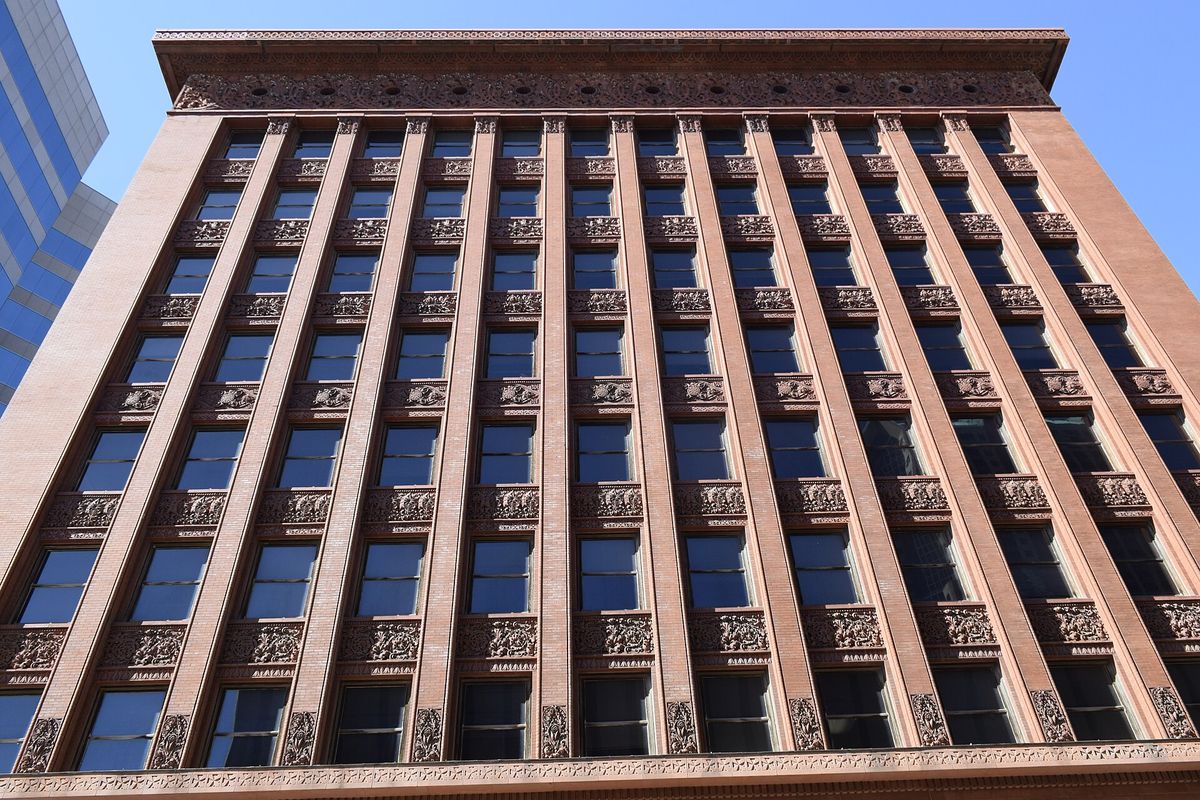
Farther east on the same street, at 701 Chestnut, stands the building in this guide’s photo. Adler and Sullivan designed it in 1891 for brewer Ellis Wainwright, and the city lists it as one of its official landmarks. It is an office building, so the visit is from the sidewalk: stand across the street and look up at the terracotta panels between the windows.
8. Busch Stadium and Ballpark Village
The Cardinals’ Busch Stadium and Ballpark Village sit side by side. Ballpark Village, at 601 Clark Avenue, is a downtown complex for dining, sports, entertainment and nightlife. The Cardinals Hall of Fame and Museum is there too, inside Cardinals Nation.
Visitors who come when there is no game can still get inside the ballpark. The Cardinals run a one-hour Classic Tour that generally includes stops in the UMB Champions Club, the Redbird Club and the broadcast booth, and every Classic Tour ticket also includes admission to the Hall of Fame and Museum. Tour stops and times change, so book through the Cardinals’ tour page.
9. Laclede’s Landing and the Eads Bridge
North of the Arch grounds, Laclede’s Landing is the old riverfront warehouse district between the Eads and Martin Luther King bridges. This is where St. Louis started. Pierre Laclède chose the site in 1763, and in 1764 Auguste Chouteau’s crew of about 30 built the first cabins and a warehouse. The Great Fire of May 17, 1849, which began on the steamboat White Cloud, destroyed 23 steamboats and almost 15 blocks, and the district was rebuilt in brick and cast iron. The district’s own history page points out Clamorgan Alley, named for Jacques Clamorgan, as a popular spot for photos of the Arch.
The Eads Bridge sits at the Landing’s south edge. James Buchanan Eads completed it in 1874, and the National Park Service calls it the first bridge across the Mississippi at St. Louis and the oldest bridge still standing on the river. It still works for a living, carrying pedestrians, cars and MetroLink trains across to Illinois.
Getting around downtown
Walking works for neighboring stops; MetroLink covers the long east-west stretch. The useful stations are Union Station (301 S. 18th Street), Stadium (401 S. 8th Street) for Busch Stadium and Ballpark Village, 8th & Pine, Convention Center, and Laclede’s Landing (200 Washington Avenue), which Metro recommends for the Arch grounds. Metro has posted a service change running September 14 through November 29, 2026: single-tracking at Union Station and Civic Center Monday through Saturday from 6pm, with evening Blue Line trains running only between Forest Park and Shrewsbury. Check metrostlouis.org before an evening trip.
One way to string it together: Union Station in the morning, a walk up to City Museum, then east along Washington Avenue to the Landing and the riverfront by late afternoon, with Ballpark Village saved for the evening.
Nearby stays
No Airbnb downtown yet
VisitingSTL doesn’t feature a stay inside downtown itself. The nearest of the three is the historic 5-bedroom Soulard home, south of downtown across I-55, whose listing describes walkable access to downtown.
View & Book on Airbnb →Quick answers
What is there to do in downtown St. Louis besides the Arch?
Union Station and its Grand Hall light show, City Museum, a walk along Washington Avenue, free tours of the 1912 Central Library, the Campbell House Museum, Soldiers Memorial, the Wainwright Building, Ballpark Village with a Busch Stadium tour, and Laclede’s Landing by the Eads Bridge.
Is Union Station in downtown St. Louis?
Yes. The city splits the center into two official neighborhoods, Downtown and Downtown West, and Union Station is in the western half, west of Tucker Boulevard.
Can you tour Busch Stadium when there is no game?
Yes. The Cardinals run a one-hour Classic Tour, and every Classic Tour ticket also includes admission to the Cardinals Hall of Fame and Museum at Ballpark Village.
Is the National Blues Museum still open?
No. The National Blues Museum on Washington Avenue closed in March 2026. It had opened in 2016.