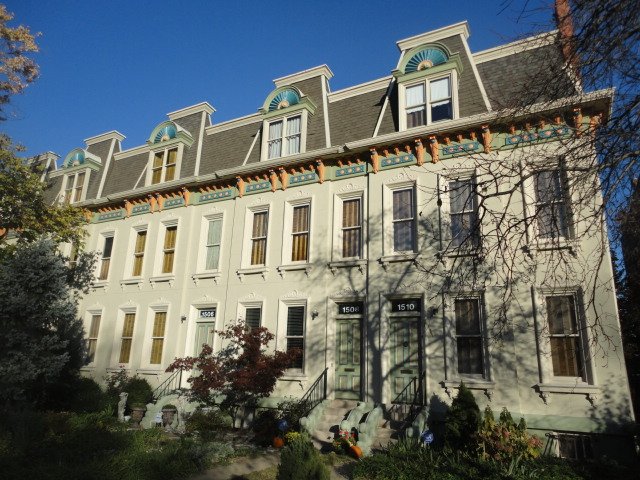
Lafayette Square is the quieter cousin to Soulard and the Central West End — a neighborhood built around a genuinely historic park, full of Victorian mansions that were, at one point, almost entirely lost. It's come back slowly and deliberately, which is part of why it still feels distinct rather than polished flat.
A park older than the Civil War
Lafayette Park was set aside from the city's common land in 1836 and formally dedicated in 1851, making it the oldest park west of the Mississippi River. It anchored a neighborhood of increasingly grand homes for decades — until May 27, 1896, when a tornado tore through St. Louis, killing 255 people citywide in what remains the deadliest tornado in the city's history. Lafayette Park lost every tree it had, and the neighborhood lost most of its housing stock. What followed was nearly seventy years of decline.
The turnaround started quietly in the late 1960s, as people began buying and restoring the long-abandoned Victorian houses one at a time. The neighborhood's Spring Home & Garden Tour, which dates back to 1969, grew directly out of that early restoration push. By 1972, Lafayette Square had become the city's first National Register Historic District.
What's actually still standing
Roughly 375 Victorian buildings survive in the historic district, and the dominant style is French Second Empire — two-story townhouses topped with a mansard third floor, dormer windows, arched openings, bay windows, and ornate cornices, most built between 1865 and the 1880s. You'll also find Italianate, Romanesque, and Queen Anne houses mixed in, faced in limestone and sandstone over brick. The park itself still has its original cast-iron fence.
Inside the park, look for the bronze Thomas Hart Benton statue, dedicated in 1868 — it's considered the first public monument in Missouri and the first large-scale outdoor bronze cast west of the Mississippi — along with a Houdon-cast George Washington statue and the Betsy Cook Pavilion, a rebuilt gazebo that still hosts summer concerts.
Where to eat
SqWires Restaurant & Market has been a neighborhood mainstay for seasonal American food with live jazz and blues on weekends. The Bellwether covers small plates and pasta with an international bent. Polite Society, on Park Avenue, and Mayo Ketchup, a fast-casual spot for Puerto Rican, Dominican, and Cuban food, round out a strip that's more varied than its size suggests. Save room at Bailey's Chocolate Bar, known locally for the Bailey's Brownie.
Still a park, not a postcard
The Spring Home & Garden Tour remains the neighborhood's signature event — the 2026 edition was the 57th annual, running with trolleys, an antique fair, and the Lafayette Square Art Fair happening in the park at the same time. There's also a self-guided Holiday Parlor Tour through decorated homes, and summer concerts in the park organized by the Arts Council of Lafayette Square. This is still a lived-in neighborhood built around a park people actually use, not a museum piece.
Getting your bearings
Lafayette Square sits just south and west of downtown St. Louis, within walking distance of Soulard, and near Tower Grove, Benton Park, and Fox Park. One notable landmark on the edge of the district: The Georgian, a Georgian Revival building at 1515 Lafayette Avenue that opened in 1912 as City Hospital, closed in 1985, and has since been converted into condos.
Nearby stays
No Airbnb in Lafayette Square yet
We don't currently manage a stay in Lafayette Square itself, but our Soulard property is an easy walk away, right in the middle of the neighborhood next door.
See Places to Stay →If Soulard is St. Louis' loudest historic neighborhood, Lafayette Square is its most deliberate one — rebuilt once by accident of history, and a second time on purpose.
← Back to all neighborhoods