Published · Updated
Most visitors come to the Missouri Botanical Garden at 4344 Shaw Blvd for the display gardens and the glass dome. Behind them sits a working plant-science operation: one of the largest herbaria anywhere, a botanical library, and a long-running effort to put the collection online. Some of it you can see on an ordinary visit and some of it only on a member tour. Status as of October 2026.
How the collection began
Henry Shaw arrived in St. Louis in 1819 and opened the Garden to the public forty years later. The science came a little earlier than the public opening. In 1857, Shaw commissioned George Engelmann, a St. Louis physician and one of the leading U.S. botanists of his day, to buy the herbarium of Johann Jakob Bernhardi from Bernhardi’s heirs. It held about 62,000 specimens gathered in the late 18th and early 19th centuries, including plants from South America, Asia, Africa and Europe. Engelmann’s own herbarium, about 98,000 specimens strong, was donated by his family in 1890.
Pressed plants last. By its own account the herbarium holds specimens collected by George Boehmer in the 1740s, by Joseph Banks and Daniel Solander on Captain Cook’s first voyage (1768–71), and by Charles Darwin on the voyage of H.M.S. Beagle (1831–36).
What 7.5 million pressed plants means in practice
A herbarium is a library of preserved plants. Collectors in the field press each specimen in newspaper folds and dry it. At the Garden the specimens are counted, recorded and frozen to kill any insects that could destroy them. Labels are prepared from the collector’s field notes, a taxonomist who specializes in that group names one specimen from each collection, and a specimen from each collection is mounted and filed. The duplicates are sent to other herbaria in exchange for specimens from their regions. The Garden trades with some 400 herbaria worldwide and says it loans an average of 25,000 specimens a year to researchers and borrows about 20,000 for its own staff.
The herbarium page puts the total at more than 7.5 million specimens. The Garden’s member-tour page says nearly 8 million, and its page for the digitization effort describes a dataset of over eight million, so the number shifts a little depending on which page you open. This guide uses the herbarium page’s figure.
Putting it online
On December 10, 2024, the Garden announced the Revolutionizing Species Identification project, funded by an anonymous $14.4 million grant that it called the largest to botany in recent years. The plan is to bring 6 million specimens online over six years and use artificial intelligence to pick out plant features, so a scientist could upload images of an unknown plant and get a fast identification. The Garden says the data will be freely available, and the project page links to a herbarium database, the one part of the collection anyone can look at from home.
What a visitor can actually see
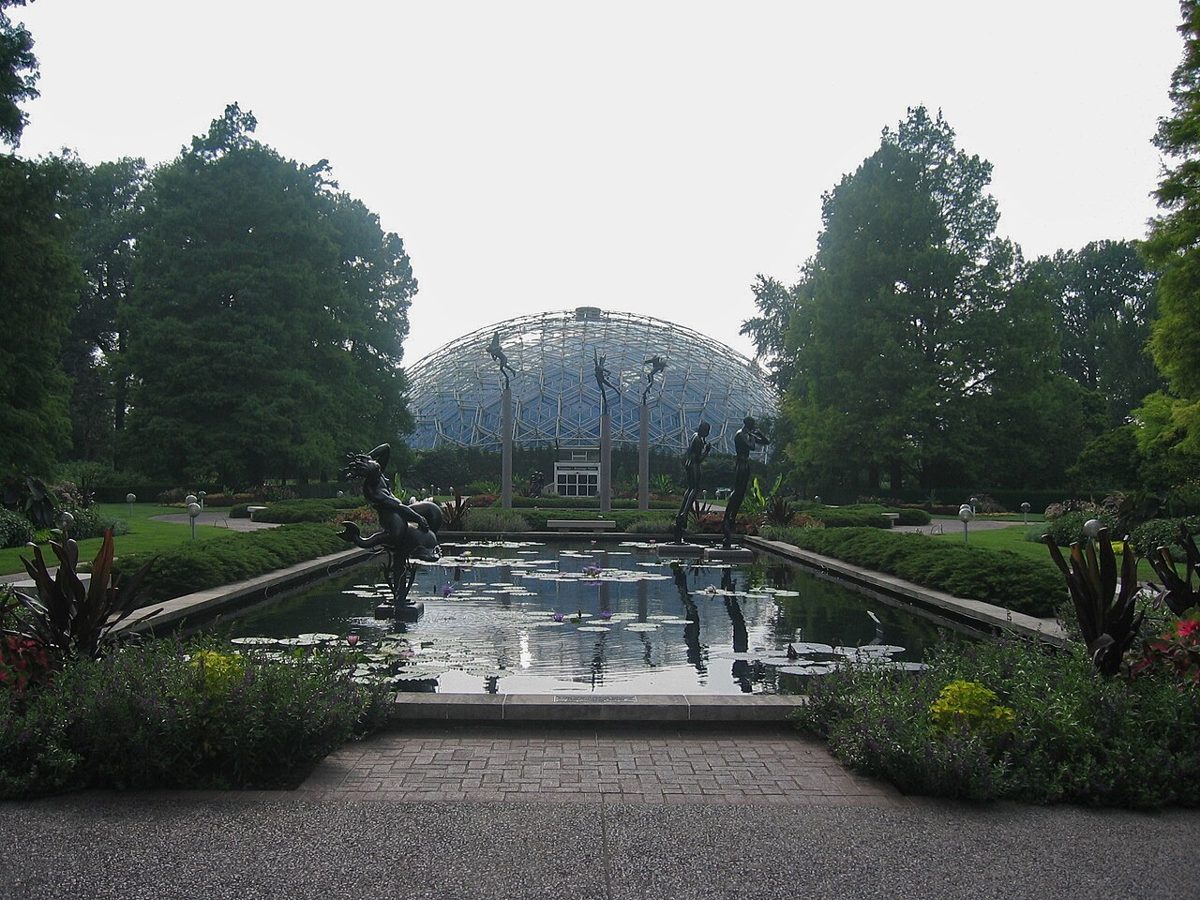
The Climatron is the easy one, and it belongs to the same story as a living collection. The Garden says it is the first geodesic dome used as a conservatory, built on the principles of R. Buckminster Fuller, and it opened to the public on October 1, 1960. St. Louis architects Murphy and Mackey won the 1961 Reynolds Award for it. The dome rises 70 feet in the center, spans 175 feet at the base and encloses about 24,000 square feet with no interior columns. Inside is a tropical rain forest setting with waterfalls, a river aquarium and more than 2,800 plants from about 1,400 tropical species, among them banana, cacao, coffee and the double coconut, which produces the largest seed in the plant kingdom. It closed for renovation in 1988 and reopened in March 1990 with 2,425 new panes of glass.
The herbarium and library are another matter. The Garden describes the Peter H. Raven Library as one of the most comprehensive botanical libraries in the world, open to the public by appointment only. For Member Appreciation Days, November 9–15, 2026, the Garden lists “Digging Deeper” tours at $10 per person, for members only, with registration required and limited space. The library tour is Tuesday, November 10, at 10 a.m. and 2 p.m.; the herbarium tour is Thursday, November 12, at the same times. Both leave from the lobby of the Bayer Center, down the block from the main entrance at 4500 Shaw Blvd. On Friday, November 13, at 10 a.m., staff of the William L. Brown Center introduce ethnobotany and show selections from its Biocultural Collection. Those are member events and dates move, so check the Garden’s own pages before planning around them.
Official pages
Herbarium: Garden herbarium page. Digitization project: Revolutionizing Species Identification. Climatron: Garden page. Member tours: Digging Deeper.
Plan the trip
Pick a base for your Garden visit
VisitingSTL features three real stays around the city, in Soulard, the Central West End and the Forest Park area. See them all and choose the one that fits your trip.
See Places to Stay →Quick answers
How many plant specimens are in the Missouri Botanical Garden’s herbarium?
The Garden’s herbarium page says more than 7.5 million specimens. Its member-tour page says nearly 8 million, so the Garden’s own pages round the count differently. The collection began with a herbarium bought in 1857.
Can I visit the herbarium?
It is not a walk-in exhibit. The Garden has offered behind-the-scenes herbarium tours as a members-only, registration-required event during Member Appreciation Days (November 9–15, 2026, $10 per person), starting from the Bayer Center lobby at 4500 Shaw Blvd.
What is the Climatron?
The Garden says it is the first geodesic dome used as a conservatory. It opened on October 1, 1960, rises 70 feet, spans 175 feet at the base and holds more than 2,800 plants in a tropical rain forest setting.
What is the Revolutionizing Species Identification project?
A project announced on December 10, 2024, funded by an anonymous $14.4 million grant, to bring 6 million herbarium specimens online over six years. It uses AI, and the Garden says the data will be freely accessible.