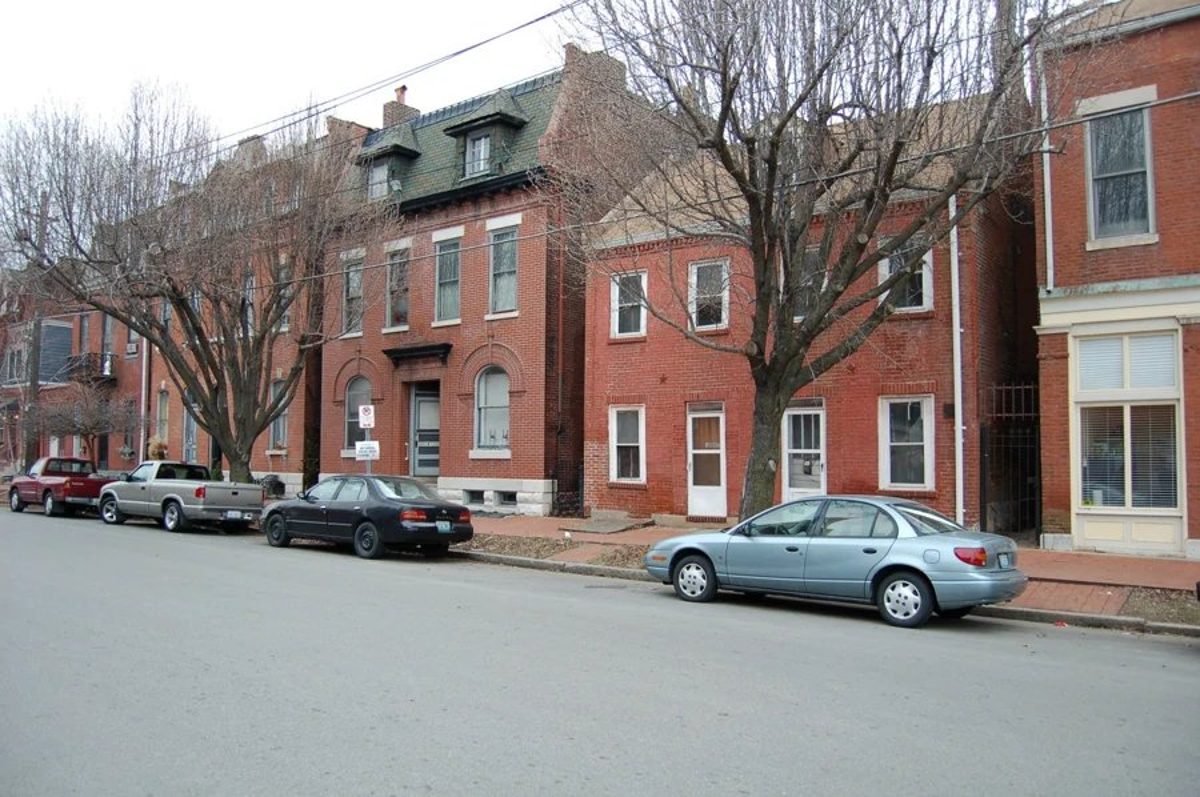
Soulard doesn't feel like a neighborhood that got restored so much as one that never fully stopped. It's the oldest residential district in St. Louis, and it still looks the part: narrow lots, brick rowhouses packed tight along streets that were laid out for horses and carts, not much room to spare. Spend an evening here and it's easy to see why people who move in tend to stay a while.
A neighborhood named for a survivor
The name comes from Antoine Soulard, a French Revolution refugee who landed in St. Louis in 1794 and, under Spanish colonial rule, became Surveyor General for Upper Louisiana — a job that came with land. His widow, Julia Soulard, is the reason the neighborhood has a market at all: in 1838 she donated the land for it "in perpetuity," formalizing a market that had already been trading on that spot since 1779. The area itself, then known as Frenchtown, was platted into the city grid around 1840, and most of what you see walking around today — the Federal and Italianate and Second Empire brick rowhouses, the narrow "mousehole" passageways between buildings — dates from that 19th-century build-out.
It nearly didn't survive to be admired. In the 1960s, the city had a demolition plan on the table for the neighborhood. Residents fought it off, and by 1972 Soulard had historic district status instead of a wrecking ball. The Soulard Restoration Group, founded in 1976, has been the neighborhood's advocate ever since — one reason the brick you're looking at is original, not reproduction.
The market that's older than the country's independence, almost
The Soulard Farmers Market is the neighborhood's anchor, and it's not a nostalgia act — it's a working market. The current building dates to 1928 and is said to be modeled on Brunelleschi's Foundling Hospital in Florence, which is a lot of architectural ambition for a place that mostly sells produce, meat, cheese, and flowers. It runs Wednesday through Saturday, with Friday and Saturday the fullest — go early on a Saturday if you want first pick of what the vendors brought in.
What to actually do once you're here
Soulard's after-dark reputation is earned. John D. McGurk's Irish Pub, on Russell Boulevard, has been pouring since 1978 and runs live Irish music nightly in a garden big enough to lose track of time in. Broadway Oyster Bar pairs Cajun and Creole cooking with blues most nights of the week. Molly's in Soulard covers the full arc from brunch to late night on its patio, and The Hi-Hat and the long-running, mosaic-covered Venice Café round out a neighborhood that clearly decided going out should mean live music, not a TV over the bar.
A quirk worth knowing before you visit: golf carts are a genuinely normal way to get around Soulard. Nobody's in a hurry, and the neighborhood is small enough that it works.
Mardi Gras, honestly
Soulard's Mardi Gras started small — a party thrown at a house on Russell Boulevard in February 1980 by a resident who wanted to chase away the winter blues — and grew from there into the city's biggest annual party. You'll sometimes hear it called the second-largest Mardi Gras in the country; that particular ranking traces back to an offhand comment from a St. Louis mayor years ago, and a closer look puts it more honestly in the top five nationally, behind New Orleans and a couple of Gulf Coast cities. Big enough either way that hotel rooms (and this Airbnb) book up well ahead of it. The Grand Parade route runs about three miles from near Busch Stadium down South Broadway through Soulard, ending at the Anheuser-Busch Brewery.
Speaking of the brewery — Anheuser-Busch's historic headquarters and brewery tours sit an easy walk from Soulard's edge, which is a nice way to spend an afternoon between market trips.
Stay in Soulard
Spacious Soulard Home — Historic 5BR, Sleeps 16
A historic 5-bedroom house in the neighborhood itself, close enough to walk to the market, McGurk's, and the brewery. Booked directly on Airbnb.
View & Book on Airbnb →Soulard rewards showing up more than once. The market crowd on a Saturday morning is a different neighborhood entirely from the bar crowd on a Friday night, and the quiet brick streets in between are worth a slow walk on their own.
← Back to all neighborhoods