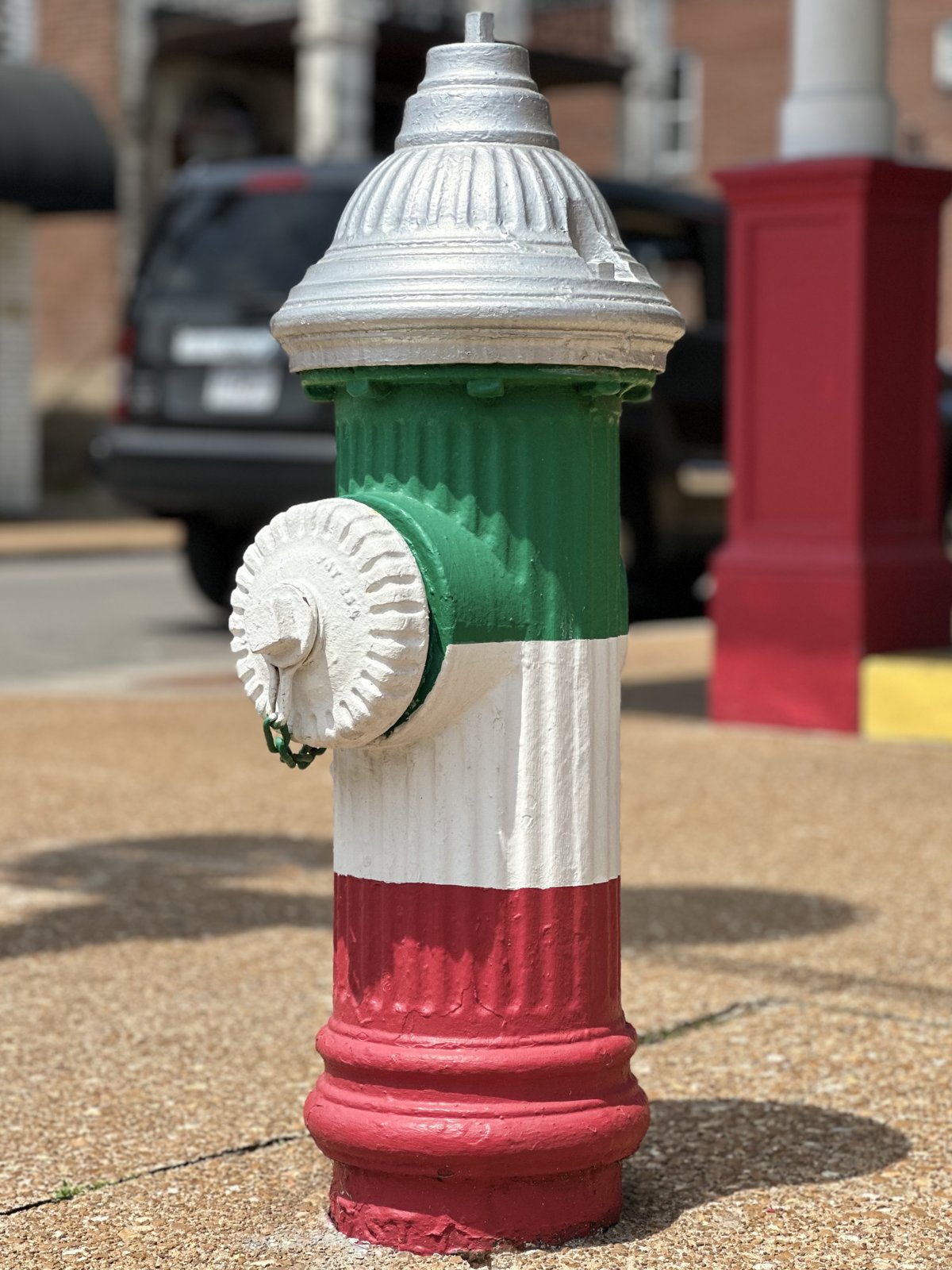
Most American "Little Italy" neighborhoods have thinned out to a street sign and a couple of restaurants trading on nostalgia. The Hill hasn't. It's a small, tight grid of brick bungalows a few miles from downtown that's stayed genuinely Italian-American for well over a century, and the easiest way to prove it to yourself is to just look down at the fire hydrants.
Built on clay, filled in by Italy
The Hill exists because of what was under it. Clay deposits were discovered in the area in the 1830s, and once the Pacific Railroad reached nearby Cheltenham in 1852, brickmaking became a real industry here — the Evens & Howard Fire Brick Company and a cluster of clay mines opened in 1854–55, and more than a dozen brick and tile factories eventually lined the nearby River Des Peres. German and Irish laborers worked the mines and brickyards first. Starting in the 1880s, Italian immigrants — mostly from Lombardy in northern Italy, with a Sicilian contingent as well — arrived for the same jobs, at first as single men in boarding houses, later sending for families. By 1910, the neighborhood was roughly 90% Italian, and it has stayed unusually intact ever since; recent estimates still put around 2,000 people of Italian descent in the St. Louis area concentrated right here.
The street that raised three Hall of Famers
Yogi Berra and Joe Garagiola grew up across the street from each other on what was Elizabeth Avenue, playing ball on a vacant lot nearby before either of them made the majors. As boys, the two of them sold Christmas trees together to benefit St. Dominic's Orphan Home. The street has since been renamed Hall of Fame Place — by most accounts, the only street in the country where three Hall of Famers once lived, counting longtime broadcaster Jack Buck. The Hill also produced three members of the U.S. team that beat England at the 1950 World Cup — Frank Borghi, Charlie Colombo, and Gino Pariani — plus Cardinals infielder Frank Crespi.
Yes, the hydrants are real
The neighborhood's fire hydrants really are painted in the colors of the Italian flag — red, white, and green — a small, deliberate tribute that shows up again in the street-sign toppers reading "The Hill" and the awnings on more than a few restaurants. It's the kind of detail that could feel like a gimmick anywhere else; here it just reads as accurate.
Where the actual eating happens
Rigazzi's, open since 1957, is the elder statesman — order the stuffed artichokes and a frozen "fishbowl" and you'll understand the fuss. Cunetto's House of Pasta, family-run since 1972, is the neighborhood's scratch-sauce standard-bearer. Gioia's Deli makes the hot salami sandwich that's become a St. Louis signature in its own right, while Amighetti's Bakery and Zia's (since 1985) cover the rest of the classic Hill menu. Milo's, founded in 1977, adds a bocce garden to the bar. For groceries, J. Viviano & Sons and Di Gregorio's are the real deal, and Missouri Baking Company and Fazio's Bakery handle dessert.
Toasted ravioli itself — breaded, deep-fried ravioli, a genuine St. Louis invention — is claimed by two Hill restaurants with a shared origin story: sometime in the 1940s, a cook at Oldani's supposedly dropped ravioli into the fryer instead of the pot, and the accident stuck around as a menu item. Oldani's split into what are now Mama's on the Hill and Charlie Gitto's, and both still claim the invention. Nobody's settled it, and that's part of the fun of asking around.
The church at the center
St. Ambrose Catholic Church, at Wilson and Marconi Avenues, has been the neighborhood's anchor since 1903, when it was founded to serve the incoming Lombard community. The original wood church burned in 1921; the current brick-and-terra-cotta building went up in 1926, designed in a Lombard Romanesque Revival style modeled on the Basilica of Sant'Ambrogio in Milan.
When to visit for the full effect
The Hill's biggest event is the Italian Heritage Parade & Festa, held the Sunday before Columbus Day and run by the Hill 2000 Neighborhood Association — the 2025 edition was the 158th annual, with a parade route ending at Berra Park for food, music, and vendors. There's also Ferragosto in August and a Carnevale celebration in February, both tied to the neighborhood's Italian community organizations.
Nearby stays
No Airbnb on The Hill yet
We don't currently manage a stay right on The Hill, but it's a short drive from our Central West End and Forest Park–area properties — close enough for a dinner trip any night of your stay.
See Places to Stay →Come hungry, and don't rush it — The Hill rewards wandering into whichever deli or bakery has a line out front.
← Back to all neighborhoods