Tower Grove is less a single neighborhood than a park with neighborhoods leaning in from every side. The park itself runs about 1.6 miles from Kingshighway Boulevard east to Grand Boulevard, and the streets that border it — Shaw to the north, Southwest Garden to the west, Tower Grove East and Tower Grove South on the other sides — all take a good part of their character from it. For a visitor, the park is the reason to come, and the blocks around it are the reason to stay for dinner.
Henry Shaw's gift to the city
The park exists because of one man. Henry Shaw, a British immigrant who arrived in St. Louis in 1819 and made his fortune in business, spent his retirement on botany. He opened the Missouri Botanical Garden on his estate in 1859, and in 1868 he donated a long strip of his land to the City of St. Louis for a public park. Tower Grove Park opened in 1872. Shaw believed parks mattered not only as ornaments to a city but for the health and happiness of the people living in it, and he designed this one accordingly: formal, planted, and meant to be walked through slowly.
The result has held up remarkably well. Tower Grove Park was added to the National Register of Historic Places in 1972 and designated a National Historic Landmark District in 1989, and it is recognized as one of the finest surviving examples of a late 19th-century American public park. It's also an accredited arboretum, and because it sits on the Mississippi Flyway, it draws birdwatchers during migration season.
Pavilions, a bandstand, and some very deliberate ruins
What sets Tower Grove apart from an ordinary city park is its Victorian architecture, scattered across the lawns like follies on an English estate. The pavilions are the best known — the Turkish Pavilion, the Chinese Pavilion, the Sons of Rest Pavilion, and the octagonal Old Playground Pavilion, built in 1870–71 with a blue bell-cast metal roof and a domed cupola. Many are still rentable picnic sites today. The octagonal Music Stand, designed by Eugene Greenleaf and built in 1872, has its own red domed roof.
The Piper Palm House, built in 1878 to overwinter the park's tropical plants and designed by George I. Barnett under Shaw's oversight, is described by the park as the oldest greenhouse west of the Mississippi River. Nearby stand two 1878 statues by Ferdinand von Miller: one of the naturalist Alexander von Humboldt, the other of William Shakespeare.
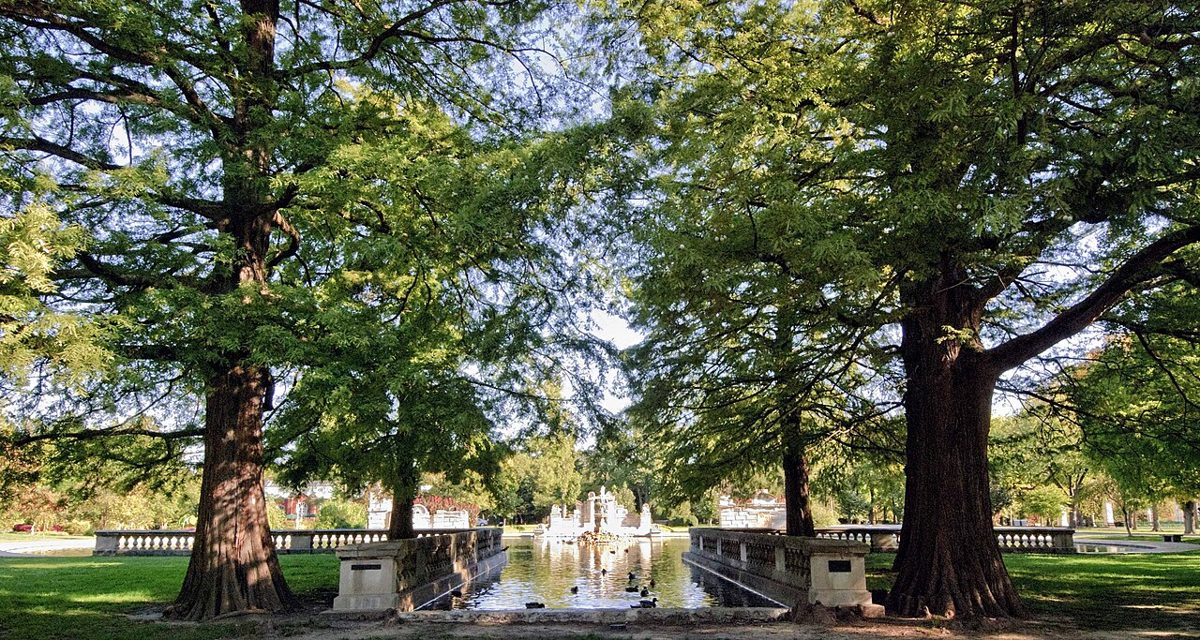
Then there are the ruins. In 1867, the Lindell Hotel in St. Louis burned. Shaw saw something in the fire-damaged stone and had it hauled to the park, where between 1872 and 1873 it was arranged around the Fountain Pond to look like the remains of a classical ruin — a fashionable landscape trick of the era. Today the Fountain Pond and Ruins is one of the park's most photographed corners.
Saturday mornings and a late-summer festival
The Tower Grove Farmers' Market, founded in 2006, sets up next to the park's Pool Pavilion on Saturday mornings from 8 a.m. to 12:30 p.m. during the growing season, with a smaller Tuesday evening market as well. It has grown into one of the city's busiest weekly gatherings — local farmers, bakers, and makers, with thousands of people drifting through on a good Saturday. The park itself is open daily from 6 a.m. to 10 p.m.
The park's biggest weekend is the Festival of Nations, run by the International Institute of St. Louis every late August. Admission is free, and the 2026 edition, held August 29–30, was its largest yet, with more than 80 countries represented across more than 100 food and craft vendors and dozens of stage performances.
The neighborhoods around the park
Tower Grove South, bounded by Arsenal Street, Chippewa Street, Kingshighway, and Grand, was once known as Oak Hill and filled in after streetcar lines reached it from downtown. Since the 1990s it has been steadily rehabbed, block by block, and its Morganford Road strip on the west side has picked up restaurants, bars, and shops along the way. Tower Grove East, across Grand, is known for its brick four-square houses — two-story cubes under pyramid or hipped roofs, built largely by German American families, often with carved entries and ornate interiors hidden behind fairly modest fronts.
Between the two runs South Grand, a business district its own organizers describe as six historic blocks of culture and creativity, and the first commercial strip in the area to be rehabbed. It's where the neighborhood goes to eat, and it's known for its international range. One long-running anchor is Jay International Foods at 3172 South Grand, a family-owned grocery since the 1970s stocked with produce, spices, and pantry staples from around the world.
The Botanical Garden next door
The Missouri Botanical Garden isn't inside Tower Grove Park — it's a separate institution on its own grounds just to the north, at 4344 Shaw Boulevard — but the two began as parts of the same Henry Shaw estate, and they're easy to pair in one day. The Garden's Climatron, opened in 1960, was one of the first geodesic-dome greenhouses, and its Seiwa-en Japanese Garden, opened in 1977, is billed as the largest in North America. Shaw's own 1849 Italianate country home, Tower Grove House, still stands on the Garden grounds.
Nearby stays
No Airbnb in Tower Grove yet
VisitingSTL doesn't feature a stay in Tower Grove itself yet, but the park is a short drive from both the Soulard and Central West End properties — easy for a Saturday market morning or an afternoon at the Garden.
See Places to Stay →Quick answers
Is the Missouri Botanical Garden inside Tower Grove Park?
No. The Garden is a separate institution on its own grounds just north of the park, at 4344 Shaw Boulevard. Both began as parts of Henry Shaw's estate.
When is the Tower Grove Farmers' Market?
Saturday mornings from 8 a.m. to 12:30 p.m. during the growing season, next to the park's Pool Pavilion, with a smaller Tuesday evening market as well.
What are the ruins in Tower Grove Park?
Stones from the Lindell Hotel, which burned in 1867, arranged around the Fountain Pond between 1872 and 1873 to look like a classical ruin.
How big is Tower Grove Park?
289 acres, running about 1.6 miles from Kingshighway Boulevard east to Grand Boulevard.
Tower Grove rewards an unhurried pace: a loop past the pavilions, a stop at the ruins, and a walk over to South Grand once the afternoon turns into dinner.
← Back to all neighborhoods