Published · Updated
Washington University’s Danforth Campus is a college campus that doubles as a piece of World’s Fair history. Its stone towers and quadrangles went up in time for the 1904 fair, its athletic field hosted the 1904 Olympics, and its art museum is a good reason to detour to the west side of Forest Park. This guide treats it the way a visitor would: what to look at, in what order, and what to confirm before you go. Admissions, rankings and student life are left to the university’s own sites.
A campus built for a fair
The hilltop was undeveloped when the university took an interest in it. By WashU’s own account, the Olmsted firm studied the site in 1895 and was impressed by its commanding position, and its plan stressed a park-like setting tied to Forest Park next door. In 1899, after a national design competition, the university chose the Philadelphia firm Cope & Stewardson to design the whole campus. The plan borrowed the quadrangles of Oxford and Cambridge and set Collegiate Gothic as the look the campus has followed since.
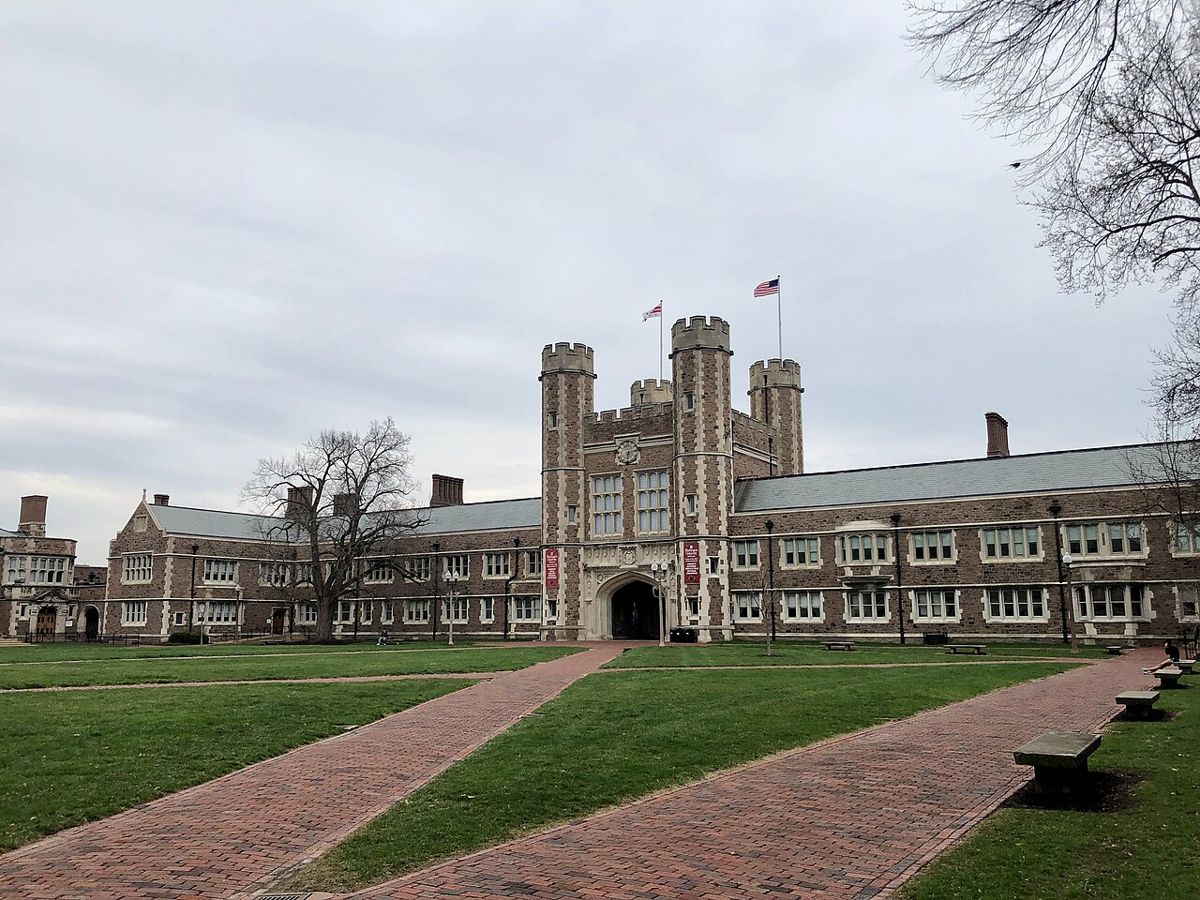
Brookings Hall, the tower at the center of that plan, had its cornerstone laid in November 1900. Before students used it, the university leased it and several neighboring buildings to the Louisiana Purchase Exposition, the 1904 World’s Fair. Brookings served as the fair’s Administration Building, and Busch Hall, the Cupples halls, Ridgley, Eads and Prince Halls were used as offices and exhibition space. Classes did not begin in the new buildings until January 30, 1905, two months after the fair closed, and the campus was dedicated at Commencement that June. The Forest Park guide covers the fair’s other surviving traces across the street.
Start at Brookings Hall
Brookings is the obvious first stop. The gothic buildings around its quadrangle, Ridgley among them, belong to the original Cope & Stewardson layout, so you are looking at the plan drawn in 1899 rather than a later imitation. Walk the quad slowly and look up: the detail is in the stonework and arches, and the buildings frame the tower from several sides.
Francis Olympic Field
Close by is the reason the campus appears in Olympic histories. Francis Field was the main venue of the 1904 Summer Olympics, the first Games held in the Western Hemisphere. It is named for David R. Francis, the former Missouri governor, 1870 WashU graduate and fair president who argued that the Games should be held in the same city as the fair. WashU calls it the oldest modern Olympic stadium still in active use. On September 21, 2019, the field was formally renamed Francis Olympic Field, and the university says it is the only U.S. venue that hosted Olympic events to be given permission to use “Olympic” in its name. A 16-by-9-foot stainless steel set of Olympic rings was installed nearby in September 2018.
It is also a working athletic facility, home to the university’s football, soccer, cross-country and track programs. Access depends on the day, so check before planning around it.
The Kemper Art Museum
If you go inside only one building, make it the Mildred Lane Kemper Art Museum. WashU puts its collection at some 8,700 artworks, with especially strong 19th-, 20th- and 21st-century European and American holdings and a growing set of international work. The museum’s address is One Brookings Drive. Hours, exhibitions and closures change, so confirm them on the museum’s own page: kemperartmuseum.wustl.edu/visit.
The campus has smaller galleries too. The Des Lee Gallery shows work by Sam Fox School students and faculty alongside local and international contemporary artists, and Steinberg Hall’s gallery hosts art, architecture and design exhibitions. WashU Libraries also mounts rotating displays from its collections, and Edison Theatre, the Performing Arts Department’s main stage, hosts local companies including The Black Rep.
Three buildings that tell the story
Past the gothic core, the campus keeps adding layers, and three buildings show the sequence:
- Bixby Hall (1926). A neoclassical building that replaced the temporary British Royal Pavilion from the 1904 fair, which had stayed on as home to the fine arts studios for more than two decades.
- Givens Hall (1932). Built for the School of Architecture.
- Steinberg Hall (1957). Designed by Fumihiko Maki, then a young faculty member and later a Pritzker Prize winner. It gave the university its first permanent exhibition space for its art collection and brought mid-century modernism to a gothic campus.
A newer chapter is the east end of campus, reworked in 2017 under landscape architect Michael Vergason. WashU says the project returns to Olmsted’s original emphasis on sustainability and walking, with new buildings placed inside that framework.
Planning the afternoon
One workable order: walk Brookings and the quad, cross to Francis Olympic Field, then finish at the Kemper. Confirm the museum’s hours first. Because this is a working university, buildings other than the museum and its public events may not be open to visitors, and the official campus visits the university offers are run by undergraduate admissions for prospective students. Its visit page is admissions.washu.edu/visit-washu.
A note on geography. The campus lies on the western boundary of Forest Park, and most of it, including almost all academic buildings, is in an enclave of unincorporated St. Louis County. The eastern parts are in the city. On foot you will not notice the line; it is one continuous hilltop of about 169 acres beside the park. Older maps and alumni still call it the Hilltop Campus. It was officially dedicated as the Danforth Campus on September 17, 2006, honoring William H. Danforth, the university’s 13th chancellor, and the Danforth family and Foundation.
Stay near Forest Park
First-floor stay on Enright Ave, Central West End
A first-floor stay with a game room and fireplace lounge, walkable to Forest Park per its listing. Booked directly on Airbnb.
View & Book on Airbnb →Quick answers
What is the Danforth Campus?
The main campus of Washington University in St. Louis, a Collegiate Gothic campus on the western edge of Forest Park. Cope & Stewardson won a national design competition for it in 1899, and the buildings were first used for classes on January 30, 1905.
What happened here in 1904?
The campus buildings were leased to the 1904 World’s Fair, which used Brookings Hall as its Administration Building. Francis Field hosted the 1904 Summer Olympics, the first Olympic Games in the Western Hemisphere.
Can I see art on campus?
Yes. The Mildred Lane Kemper Art Museum holds some 8,700 artworks, with strong 19th-, 20th- and 21st-century European and American collections. Check the museum’s own visit page for current hours and exhibitions.
Is the campus in the city of St. Louis?
Partly. The campus sits at the western boundary of Forest Park. Most of it, including almost all academic buildings, is in an enclave of unincorporated St. Louis County, and the eastern parts are in the city.